

From Pixels to Permanence: Restoring the Moral Authority of the Monument
- Damien Walker
- Dec 21, 2025
- 5 min read
Why has every civilisation that understood eternity chosen to build in stone? It was not out of excess or spectacle, but from the quiet certainty that what was being made was not merely for the present.
Stone was never selected for convenience. It resists speed, refuses revision, and carries consequence. It does not bend to fashion or urgency, and once shaped it does not ask to be explained. Stone waits, and in its waiting it speaks with an authority that language rarely achieves. This is the Theology of Material: a refusal to participate in the ephemeral.
We live in a culture saturated with noise. Images multiply without consequence. Language circulates endlessly and expires just as quickly. Visibility is mistaken for meaning. Yet within Catholic theology, truth has never been established by volume. Revelation is not noisy. The sacred does not shout. Silence, when grounded in truth, speaks louder and lasts longer than words, and stone understands this instinctively. Christ Himself names this order in Luke 19:40: “I tell you, if these were silent, the stones would cry out.” Stone does not require permission to speak. When truth is present, it bears witness simply by remaining.
Sacred Scripture does not treat stone as neutral matter Altars are stone because sacrifice demands permanence.
Tombs are stone because death requires memory. The Law is given on stone tablets because covenant is not provisional Christ names Simon Peter as rock and builds His Church upon him not as metaphor alone, but as a statement about stability, continuity, and visible foundation. Stone is chosen because it bears responsibility It remembers when people forget. It carries truth beyond the lifespan of those who shape it. A monument in this tradition is not content. It is not messaging or decoration. A monument is a judgment that something has entered the realm of what must not be allowed to disappear.
Consider the apostles encircling the crown of St Peter’s Basilica. They are not decorative embellishments. They are placed at height, wrapped around the summit of the Church’s principal basilica as witnesses to apostolic foundation and succession. They face outward, not inward. Their function is not intimacy but proclamation. They do not invite inspection; they assert presence. This is Visual Ecclesiology: Authority rendered visible without explanation.
The same logic governs the interior. The colossal statues lining the basilica form a deliberate procession. As the faithful move through the nave, their bodies are guided without instruction toward the altar. This is not spectacle; it is sacramental order expressed spatially. The saints do not compete with the altar; they lead toward it before doctrine is articulated, the body is already instructed. The space is designed to move you forward, not metaphorically but physically. Every proportion, every alignment, every measured increase in scale recalibrates the body as it advances. The Church does not ask you to understand first. She makes you move, and in moving, you are formed. This forward movement matters because truth is not static. Stone does the work words cannot. Their bodies know before their minds do. This is Bodily Formation in its most uncompromising form.
This same understanding shaped the civic world at its most intentional moments. Washington DC was not conceived as a picturesque city, but as a monumental one. Its planners employed classical proportion, Axial Order, and stone construction to express continuity, authority, and civic memory. The city was designed to be read bodily, not consumed visually. Within that landscape, the Lincoln Memorial remains a demonstration of how monumentality works. Abraham Lincoln is not presented as a personality to be interpreted, but as a figure entrusted to stone. The scale slows the visitor. The material imposes silence. The architecture insists on reflection before explanation.
Across the Atlantic, in London, The Cenotaph stands as an empty tomb built to hold the weight of the fallen when there is no grave to visit. Its power lies in refusal the refusal to explain what can only be acknowledged. That restraint was made unmistakable during the funeral procession of Elizabeth II. As her coffin passed the Cenotaph, the Royal Family acknowledged it. No speech was given. No gesture exaggerated. The city watched memory move through stone, and the moment burned itself into collective consciousness precisely because nothing was said.

This instinct culminates at the Tomb of the Unknown Warrior in Westminster Abbey. Here, the monument is not merely a marker but a boundary. It is the only grave in the Abbey upon which no one may walk. Even the most powerful heads of state, on arrival in London, must stand in silence before this black marble. These acts are not ceremony; they are the acknowledgment that some sacrifices cannot be repaid, only remembered. Stone holds what language cannot return.
In the southern hemisphere, this shaped both Australia and New Zealand. In Australia, the Australian War Memorial and the Shrine of Remembrance use architecture and landscape to slow the body and quiet the mind. In New Zealand, the Auckland War Memorial Museum carries memory through elevation. Christchurch once understood monumentality as civic structure, where the Bridge of Remembrance interrupts the city deliberately, forcing pause as part of ordinary movement And yet, this practice has largely vanished.
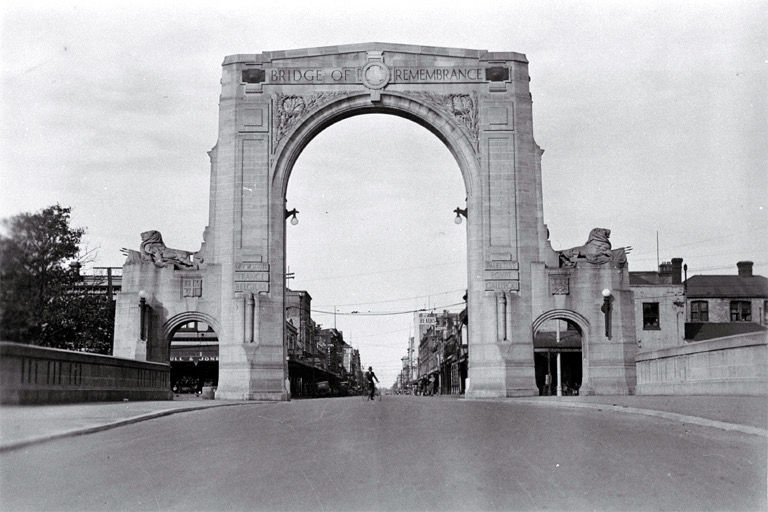
What happened to the days when a school remembered its founder in stone? When a patron, a priest, or a saint was immortalized with a realized, clear presence rather than a distorted, fleeting impression?
Today, memory is reduced to an A3 printout stuck up with bluetack on a wall. Or a temporary poster, or a website page, or a screensaver this is not humility It is the loss of seriousness. The shift is not aesthetic but theological. When a culture ceases to build monuments, it is because it no longer believes anything is stable enough to merit permanence. Authority becomes provisional. Memory becomes optional stone once bore the weight of meaning. Now, meaning is outsourced to pixels and paper.
This returns us to the discipline of stone, and the sculptor who understood it with ruthless clarity.
When Michelangelo chose marble for the Pieta, he did so because it demanded Self-Overcoming. Marble allows no shortcuts. Every strike is permanent. To carve in marble is to submit oneself to judgment by time. The sculptor stands facing the future while carving. The viewer stands in the future looking back. This exchange across centuries is only possible because stone endures. Marble carries belief forward when language fails. Monumentality is not aesthetic; it is a Moral Act. Some things cannot be repaid. They can only be held. Stone does not argue. It remains. It does not persuade; it testifies. It does not react; it remains.

The early builders accepted consequence. They worked forward knowing judgment would come later, when explanation no longer mattered. To build now is not merely to fabricate an object; it is to restore continuity. The greatest works of Catholic civilisation are neither contemporary nor nostalgic. They are trans-temporal. Sacred art was never meant to keep pace with the world; it was meant to outlast it.
The mortar that once bound belief, memory, and discipline has eroded. The very mortar of civilisation has been corroded.
The real question is not whether a monument feels relevant today, but whether it will still speak when speed has moved on and explanation has failed.
Are we still willing to build for those who will one day look back at us, or have we decided that the present moment is all that deserves to endure?


Comments